AI for Healthcare Staffing: 5 Workflows That Free Up Your Team
Artificial intelligence in healthcare staffing is not a futuristic concept. It is already handling shift notifications, credential checks, onboarding steps, and client reporting at agencies that figured out where to plug it in first.
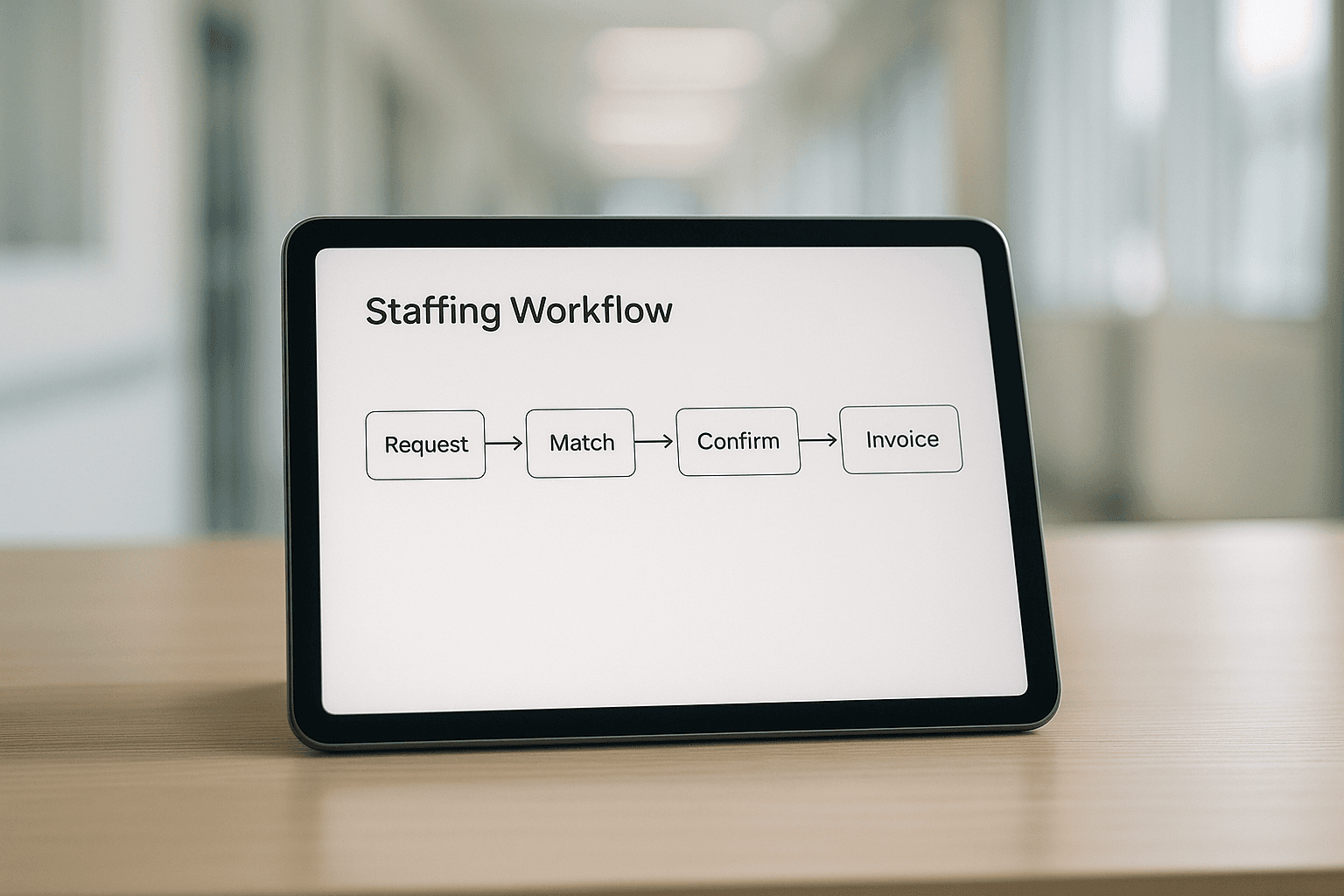
When healthcare staffing agencies ask about AI, they usually mean one of two things: a chatbot that answers questions on their website, or the kind of technology that sounds impressive but does not map to anything specific in their operation. What they are almost never thinking about is the five places in their existing workflow where AI and automation are already solving real problems at agencies that look like theirs. Here are those five places, in order of the return they deliver.
Workflow 1: Shift Filling and Worker Notification
When a last-minute shift opens, the coordinator typically starts calling through a list of available workers. The first person who picks up and says yes gets the shift. Everyone else gets a missed call from a number they do not recognize. An automated shift filling system does this differently: when a shift opens, a broadcast message goes to every eligible worker simultaneously with the shift details, the rate, and a one-tap response. The first worker to confirm gets it. The system logs the response, sends a confirmation, and notifies the coordinator that the shift is filled. The coordinator does not touch this until they see the filled notification.
Workflow 2: Credential Verification and Compliance Tracking
Credential expiry is one of the highest-risk areas in healthcare staffing. A worker with an expired certification who gets placed creates liability for the agency. Manual tracking means someone maintains a spreadsheet, remembers to check it, and follows up by hand. Automated credential tracking means a system that monitors every worker's certification status, sends renewal reminders at 90, 60, and 30 days, receives the updated documents, logs them to the worker profile, and removes the worker from eligible placements if credentials lapse without renewal. Nobody forgets to check the spreadsheet because there is no spreadsheet to check.
Workflow 3: Client Invoicing and Payment Follow-Up
Once a shift is approved, the invoice should generate itself. In a properly automated operation, it does. Hours from the approved timesheet flow into the invoice automatically, the invoice goes to the correct billing contact on the agreed schedule, and follow-up happens at preset intervals until payment is recorded. An agency processing 200 placements a month should not have a coordinator spending four hours a week on invoice follow-up. With automation, they spend zero hours on it unless something flags for review.
Workflow 4: New Worker Onboarding
Worker onboarding in healthcare staffing has a standard set of steps: application, background check request, reference check, document collection, credential verification, and system setup. Each step has a dependency on the previous one, a follow-up action if the worker does not respond, and a handoff to the next step when complete. This is exactly the kind of process automation was built for. A worker who completes their application gets an automated welcome and next-steps sequence. Each stage completion triggers the next. Stalled applications get a follow-up prompt. The coordinator sees a clean status view of every active application, with flags only where human judgment is actually needed.
Workflow 5: Reporting and Performance Summaries
Most agency owners want a weekly summary of placements, fill rates, revenue, and outstanding invoices. Most of them get it by spending an hour on a Friday pulling numbers from three different places and pasting them into a spreadsheet. Automated reporting runs on a schedule, pulls from every connected system, formats the summary, and delivers it before you sit down. The owner's Friday afternoon is not a reporting exercise. It is time to act on what the report says.
Case Study
Healthcare Staffing Agency
Automated shift filling, credential tracking, and invoice processing let the team scale volume without adding coordinators. All five workflows now run without manual intervention.
Which of these five workflows is costing your team the most time right now? Bring that answer to a call. We will show you exactly how to fix it first and what it would take to get the rest running on autopilot.
Book a Strategy CallFree Resource
Get the automation playbook.
Practical guides on what to automate first, sent to your inbox. No fluff.