How Much Does Business Automation Actually Cost? A Transparent Breakdown
Automation pricing is one of the most opaque corners of the tech industry. Here is an honest breakdown of what simple, mid-complexity, and full operational automation actually costs and how to evaluate whether the return is there.
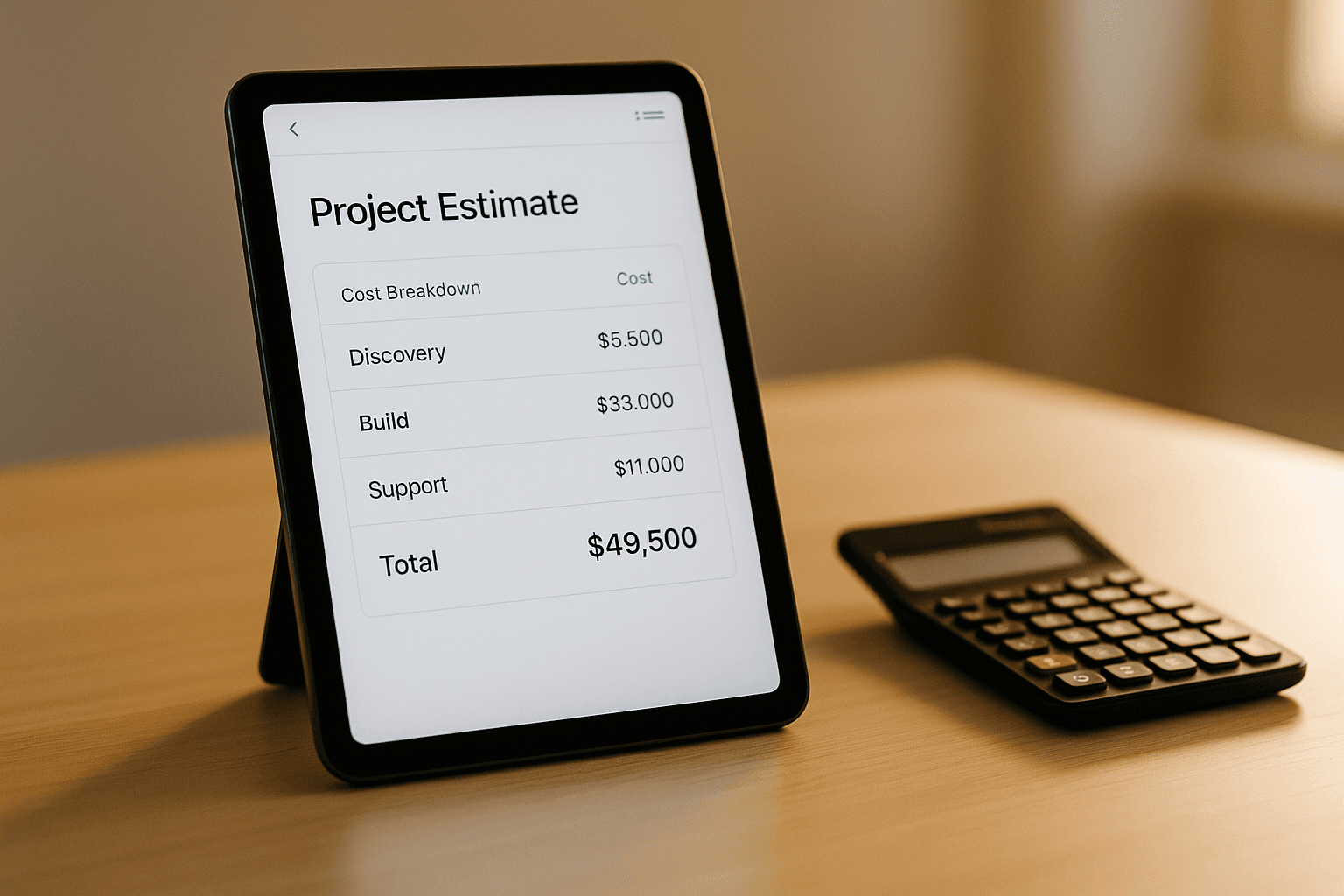
One of the most common things we hear in early calls is some version of: I looked into automation a while back and nobody would give me a straight number. That is an accurate description of how a lot of agencies operate, because the range is genuinely wide, and because vague answers make it easier to qualify for a large budget. We are going to do the opposite. Here is how automation projects are actually priced, with real ranges and the variables that drive costs in either direction.
The Variables That Drive Automation Cost
- Complexity of the process being automated: a three-step linear workflow costs less than a multi-branch decision tree with exceptions and edge cases.
- Number of systems that need to connect: integrating two tools that have APIs is straightforward. Building custom connectors for legacy systems with no API is not.
- Volume of data being processed: a system handling 50 transactions a month scales differently than one handling 5,000.
- Whether AI is involved: adding language understanding or decision-making to a workflow adds cost and maintenance.
- Testing and iteration requirements: complex business logic requires more rounds of testing before it runs reliably in production.
What a Simple Automation Costs
A simple automation is a single workflow that connects two or three existing tools and handles one clear process. Examples: new form submission triggers a CRM entry and sends a confirmation email. Invoice sent triggers a follow-up sequence after 7 days. Job marked complete triggers a client satisfaction survey. These automations typically build in one to two weeks and cost in the range of $1,500 to $5,000 depending on the tools involved and any custom logic required. Ongoing costs are usually the tool subscriptions already in place plus minimal maintenance.
What a Mid-Complexity Automation Costs
Mid-complexity automation covers a full workflow with multiple steps, conditional logic, and several systems connected. Examples: end-to-end booking flow from client request through scheduling, confirmation, reminders, and post-job follow-up. An onboarding sequence that collects documents, checks completeness, routes to different tracks based on responses, and logs everything to a CRM. An invoice processing system with discrepancy detection and automated follow-up. These typically take four to eight weeks and cost $8,000 to $25,000, depending on complexity.
What a Full Operational Rebuild Costs
A full operational rebuild is a new platform or a comprehensive automation layer across the entire business operation. This is custom software plus automation plus AI, designed to replace a stack of disconnected tools. The range here is wide: $30,000 to $150,000 or more for enterprise-grade systems, but most small-to-mid-size business rebuilds land in the $40,000 to $80,000 range. The return at this level requires a clear picture of what the current operation costs in manual time, errors, and capacity limits.
Where the Return Math Actually Works
The return on automation works when the cost of the manual process exceeds the cost of the automation over 12 to 24 months. For a simple automation that costs $3,000 to build, you need to recover $3,000 in saved time or captured revenue within a reasonable window. At $22 per hour and 10 hours per month of manual work eliminated, that is under 14 months. For a $20,000 mid-complexity build, you need to recover $20,000 in value, which at 40 hours per month of coordinator time saved at $28 per hour, plus one or two recovered deals per month, happens in under 18 months.
The Question Nobody Asks But Should
What is the cost of not automating? Not in the abstract, but in your specific operation right now. Every month the manual process continues is a month where the same errors happen, the same hours get spent on the same tasks, and the capacity ceiling stays where it is. The cost of inaction is not zero. It is the cumulative manual labor cost, the revenue lost to slow response times, and the growth that did not happen because the operations could not handle the volume. That number usually makes the automation cost look very reasonable.
Case Study
First Point Cleaners
A mid-complexity scheduling and reminder automation paid for itself in the first quarter through recovered appointment revenue and coordinator time savings.
Before we quote anything, we want to understand your current operation well enough to tell you whether automation has a real return for you. Book a call and bring your honest numbers: time spent, average job value, and where things currently fall through the cracks.
Book a Strategy CallFree Resource
Get the automation playbook.
Practical guides on what to automate first, sent to your inbox. No fluff.