Healthcare Staffing Automation: How to Eliminate 80% of Your Admin Work
Healthcare staffing agencies run on paper, phone calls, and spreadsheets that nobody has time to maintain. Here is what the admin load actually costs you and what a fully automated operation looks like.
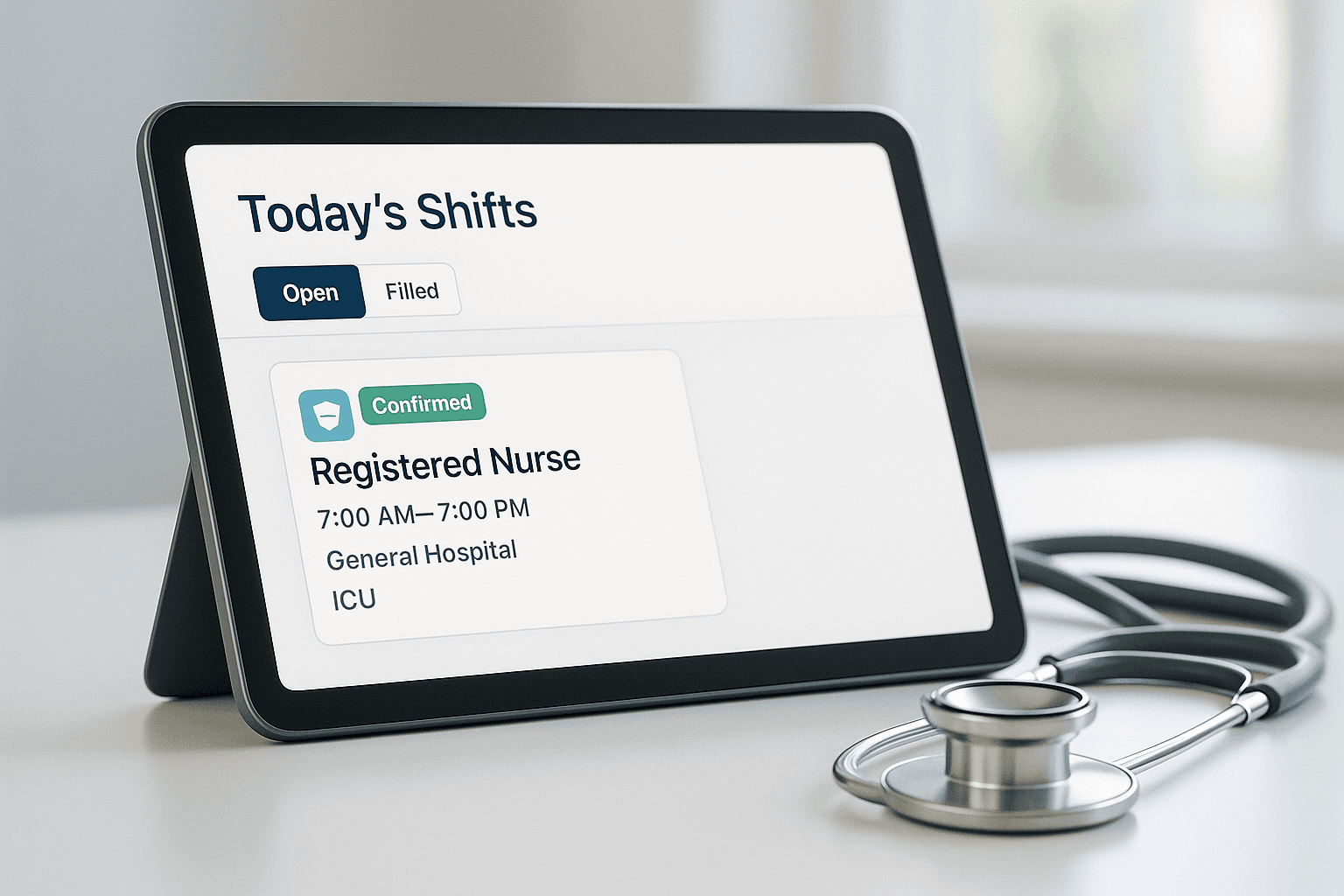
A healthcare staffing agency fills shifts. That is the job. But spend one day inside any mid-size agency and the actual job looks nothing like that. It looks like chasing timesheets, reconciling hours against invoices, calling workers to confirm shifts that were confirmed last Tuesday, manually updating credential expiry dates, and re-entering information from one system into another because the systems refuse to communicate. The actual job is buried under the infrastructure required to do the actual job.
This is not a people problem. The coordinators are not inefficient. The process is inefficient. The tools were added one at a time to solve individual problems, and nobody has ever stopped to look at the full chain from shift request to paid invoice and asked how many steps in that chain actually need a human.
Where Healthcare Staffing Agencies Lose Their Best Hours
We mapped the operations of a healthcare staffing agency running about 200 placements a month. The full workflow from client request to collected payment involved 34 distinct steps. Eleven of those steps required a coordinator to manually move information from one place to another. None of the eleven required any judgment whatsoever. They were pure data entry: copying a name from an email into a spreadsheet, updating a status from pending to confirmed, sending a message that said the same thing every time.
At 200 placements a month, those eleven steps were happening thousands of times. The coordinator team was spending an estimated 22 hours per week on tasks that a properly configured automation would handle in milliseconds.
The Six Workflows Most Agencies Still Do By Hand
- Shift confirmation: calling or texting workers to confirm they received the booking, then manually logging the confirmation.
- Credential tracking: checking expiry dates manually, sending renewal reminders by hand, updating records after documents arrive.
- Timesheet collection: emailing or calling workers to submit timesheets after shifts, chasing late submissions.
- Timesheet-to-invoice reconciliation: comparing hours worked to booked hours, flagging discrepancies, preparing invoice line items.
- Invoice delivery and follow-up: sending invoices to clients and then chasing payment when it does not arrive on schedule.
- Onboarding new workers: sending documents, collecting signatures, filing credentials, and following up on incomplete applications.
What a Fully Automated Staffing Flow Looks Like
When a shift is confirmed, the system sends the worker a confirmation automatically. Two hours before the shift, an automated reminder goes out. After the shift, a timesheet submission prompt is triggered. When the worker submits their hours, the system compares the logged time to the scheduled time, flags anything outside tolerance, and routes it for approval. Once approved, the invoice is generated and sent to the client. Seven days after invoice delivery, if no payment is recorded, a follow-up goes out. The coordinator does not touch any of this unless something flags for review.
Credential management runs on a separate track. When a certification expiry date is within 90 days, the worker gets an automated reminder. When documents are submitted, the system logs them and updates the credential record. The coordinator sees a clean status dashboard, not a stack of emails to sift through.
Case Study
Healthcare Staffing Agency
Manual shift confirmations, credential checks, and invoice follow-ups replaced with a fully automated flow. The team now handles 40% more placements with the same headcount.
The One Number That Changes the Conversation
A coordinator in a healthcare staffing agency earns somewhere between $45,000 and $65,000 per year. If 40% of their week is manual data movement, a conservative estimate based on what we see, you are paying roughly $20,000 per coordinator per year for tasks that automation handles at a fraction of that cost. At three coordinators, that is $60,000 a year in salary allocated to copy-paste work. The automation to eliminate most of that work typically costs a small fraction of that, runs continuously, and scales with volume at no additional staffing cost.
The ROI conversation is not really about the technology. It is about what you are currently paying to not have it.
If you are running a healthcare staffing agency and your coordinators spend more than two hours a day on confirmations, timesheets, or follow-ups, we can map exactly what is automatable and what it would take. Book a thirty-minute call and we will show you the numbers.
Book a Strategy CallFree Resource
Get the automation playbook.
Practical guides on what to automate first, sent to your inbox. No fluff.