7 Signs Your Business Is Ready for AI Automation (And 3 Signs It Isn't)
Not every business should automate right now. Here are seven signs that the conditions are right and three signs that automation would be money well wasted until something changes.
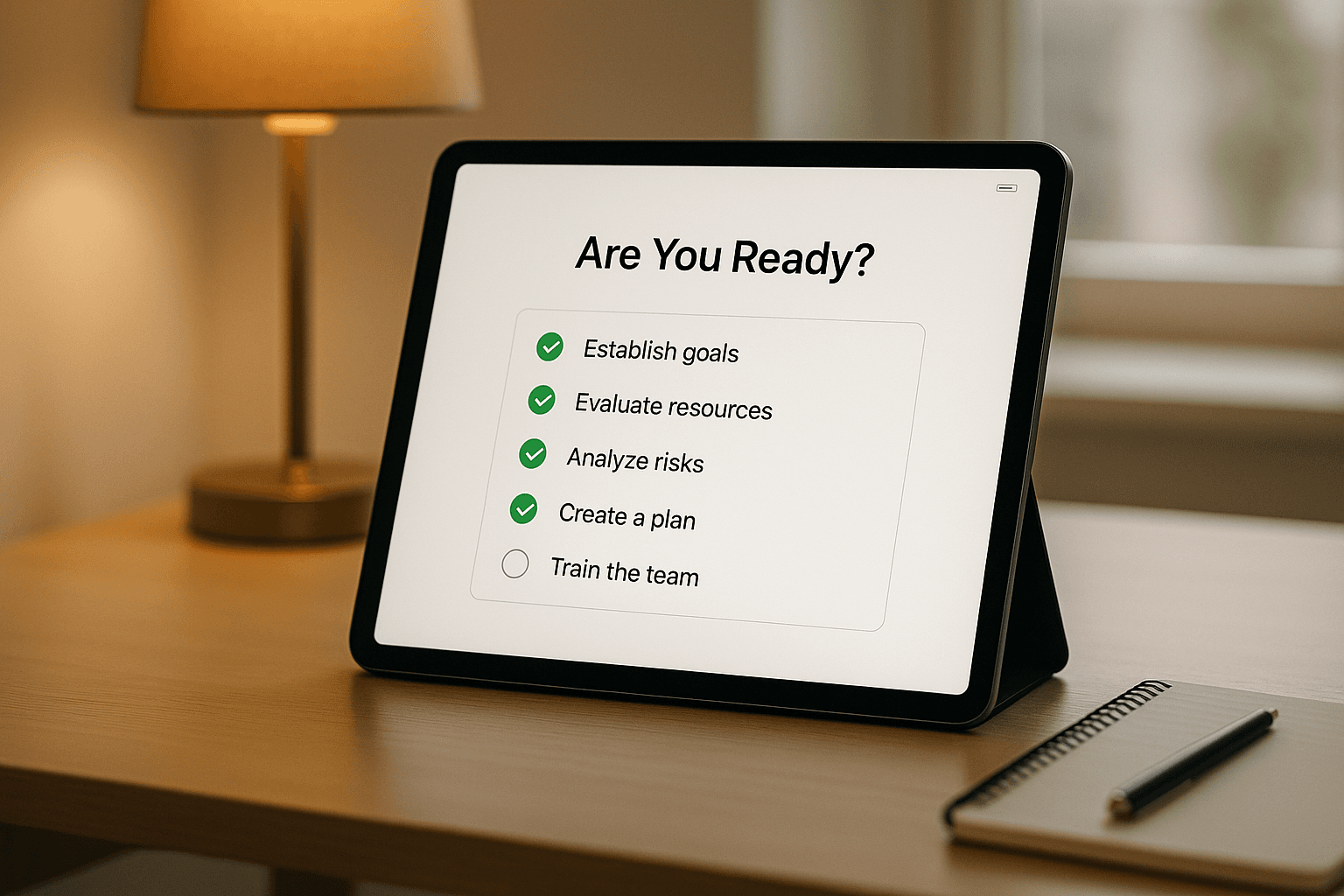
The businesses that get the most value from automation are not necessarily the largest or the most technical. They are the ones where the right conditions are in place. Automation built on a stable, repeatable process works remarkably well. Automation built on top of a process that is still being figured out creates expensive infrastructure for the wrong workflow. Before investing in automation, it helps to know which situation you are in.
7 Signs You Are Ready
- Repetitive tasks are eating hours your team should spend on higher-value work. If you can identify tasks that happen every day or every week, follow the same steps every time, and require no judgment to execute, those are automation candidates, and you probably have more of them than you realize.
- The same mistakes keep appearing. Data entered in the wrong field. A follow-up that did not go out. A confirmation that never arrived. When errors are predictable and repeatable, they are usually symptoms of a manual process that should be automated.
- Growth is limited by headcount. When adding 30% more clients would require hiring a full-time person to handle the administrative load, automation is often the lever that lets you grow without the proportional cost increase.
- Your team hates a specific task. Not because they are complaining, they might never say it, but because you can see the energy it takes to sit down and do it. That task is usually a perfect automation candidate: repetitive, low-judgment, and demoralizing at scale.
- Your tools do not talk to each other. If information lives in three places because the tools do not integrate, and someone manually keeps them in sync, that person is doing automation's job by hand.
- Leads come in when your team is unavailable. If you get inquiries in the evenings, on weekends, or during periods when the team is on-site and not watching email, and those inquiries go hours without a response, you are losing business to competitors who automated their first-contact response.
- You are growing in revenue but not in profit. When volume goes up and margin stays flat or shrinks, operational inefficiency is usually the explanation. The business is growing faster than the infrastructure supporting it.
3 Signs You Should Wait
- Your processes are still changing. If you revise how you handle bookings, onboarding, or follow-up every few months, building automation on top of those processes is premature. Automate what is stable. Wait on what is still being designed.
- Nobody is using the tools you already have. If the CRM your team is supposed to use is mostly empty, or the scheduling system has workarounds that everyone uses instead of the actual features, adding automation to that layer will make a dysfunctional system faster at being dysfunctional. Fix adoption first.
- The budget requires a return within 60 days. Automation projects are investments with payoff timelines of three to twelve months, depending on complexity. If cash pressure means the numbers need to work in under two months, the wrong thing to do is rush a build. The right thing to do is identify the single highest-impact fix and do only that.
The honest answer for most businesses is that some things are ready to automate now and some things are not. The work is figuring out which is which, starting with what is ready, and building from there.
Case Study
Junk Removal Company
A business that was growing in volume but flat in margin automated scheduling and dispatch first — the single highest-impact fix, not a full system overhaul.
Not sure which category you fall into? Walk us through your operation for 30 minutes. We will tell you honestly what we see and whether the timing is right, including if the answer is to wait.
Book a Strategy CallFree Resource
Get the automation playbook.
Practical guides on what to automate first, sent to your inbox. No fluff.